
How long does grass seed take to grow?
As a quick answer, grass seed usually begins to show visible growth within 1 to 2 weeks when conditions are suitable.
However, there is a difference between seed germinating and a lawn being fully established. Germination is the first stage. Establishment takes longer because the young grass needs time to develop roots, thicken out and become strong enough to cope with mowing and foot traffic.
The timeline below gives a simple overview of what usually happens between sowing and the first mow. Some areas may grow faster than others. This is normal, especially if parts of the lawn receive more sun, hold moisture better or have better seed-to-soil contact.
Grass seed growth timeline: from sowing to first mow
A simple way to understand grss seed growth is to think of it as a timeline:
Sowing → Germination → Visible growth → Thickening → First mow → Establishment
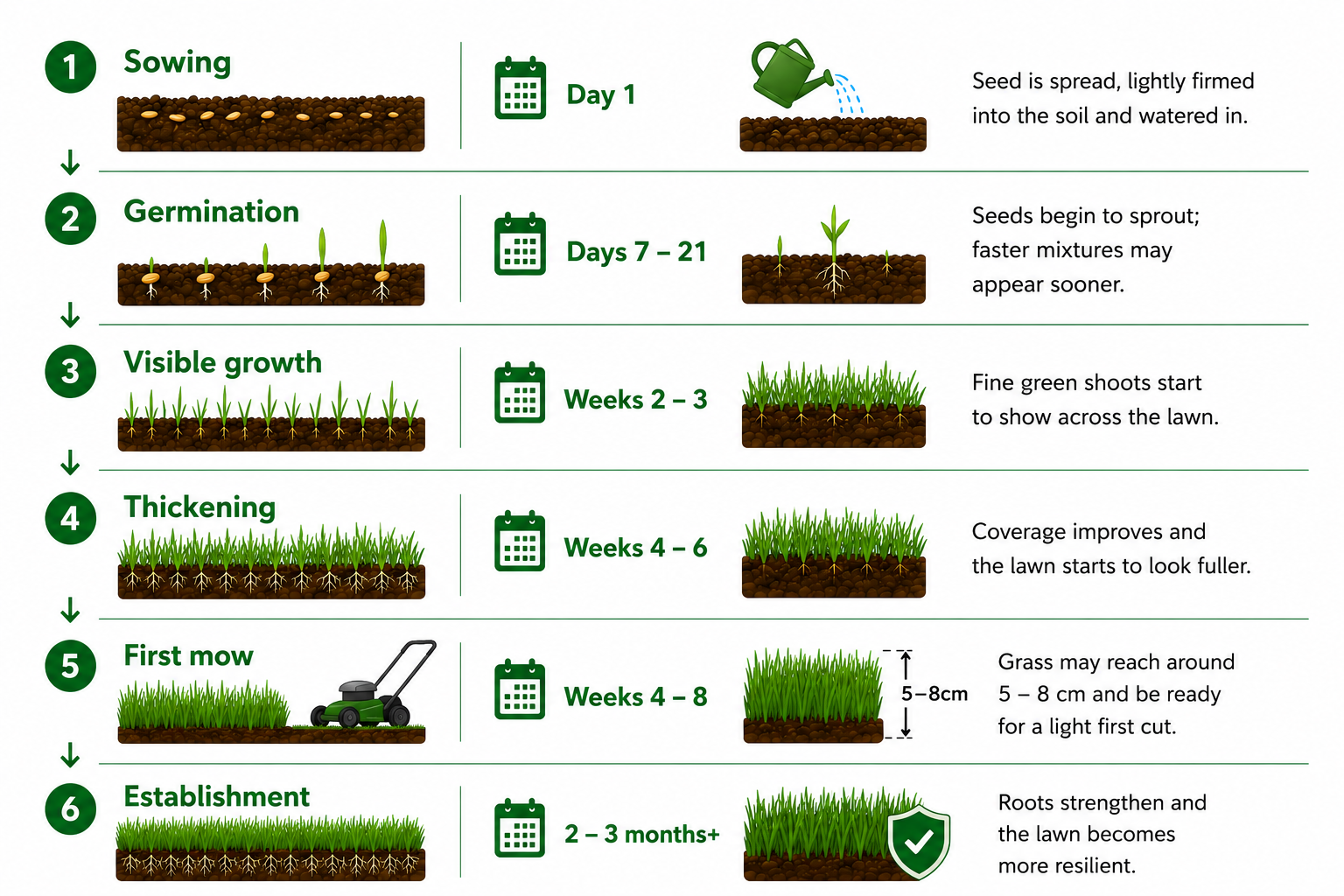
Fast-establishing seed mixtures are usually chosen where quicker visible results are important, such as lawn repairs or patching. Slower-establishing mixtures, such as fine lawn seed, may take longer to fill out but can produce a neater, more ornamental finish.
Some areas may grow faster than others. This is normal, especially if parts of the lawn receive more sun, hold moisture better or have better seed-to-soil contact.
How long does grass seed take to germinate?
Grass seed usually takes around 7 to 21 days to germinate, although some mixtures can be quicker and others may take longer.
Germination is the stage where the seed wakes up and starts growing. The first growth happens below the surface as the seed takes in moisture and begins producing roots. After that, the shoot pushes up through the soil and becomes visible.
The first signs of growth are usually very fine green shoots. At this stage, the lawn may still look thin or patchy. This is normal. The grass needs time to develop roots, produce more leaf growth and thicken across the surface.
What affects how quickly grass seed grows?
Temperature
Grass seed needs warmth to germinate. If the soil is too cold, growth will be slow even if the weather feels mild. This is why seed sown very early in spring can take longer to appear.
In the UK, spring and autumn are usually the best times to sow grass seed because temperatures are milder and there is often more moisture available.
Season
The time of year makes a big difference.
Spring sowing can work well once the soil has warmed up, but dry spells may mean more watering is needed. Autumn is often ideal because the soil is still warm, rainfall is more reliable, and there is usually less competition from weeds.
Summer sowing can be successful, but only if the seedbed is kept consistently moist. Winter sowing is generally slower because low temperatures reduce germination and growth.
Soil conditions
Grass seed performs best in a fine, firm seedbed with good contact between the seed and the soil.
If the ground is compacted, uneven, dry, waterlogged or full of thatch, the seed may struggle to establish. Good preparation gives the seed the best chance of growing evenly.
Watering
Water is essential during germination. If grass seed dries out after it has started to germinate, the young seedlings may fail.
The aim is to keep the surface consistently moist without flooding it. Light, regular watering is usually better than occasional heavy watering in the early stages.
Seed mixture
Different seed mixtures grow at different speeds. Some are designed for quick establishment, while others are chosen for a finer appearance, shade tolerance, drought tolerance or heavy wear. Choosing the right seed for the location is important because a family lawn, shaded garden, dry bank, sports area or heavy-use space will each need a mixture suited to those conditions.
The next section compares the main seed approaches in more detail.
Fast vs slow germinating grass seed: what is the difference?
Not all grass seed mixtures grow at the same speed. Some blends are created to establish quickly, while others are designed for appearance, durability or challenging conditions.
| Seed approach | Best suited for | What to expect |
|---|---|---|
| Fast-germinating seed | Repairs, patching and quicker visible results | Shoots may appear sooner in suitable conditions, helping the area green up faster. |
| Hard-wearing seed | Family lawns, play areas and high-use spaces | Good establishment with stronger tolerance once mature. |
| Fine lawn seed | Ornamental lawns and neater finishes | Often slower to establish, but gives a finer, tidier appearance. |
| Shade-tolerant seed | Areas with lower light | Designed for shaded conditions, although growth may still be slower than sunny areas. |
| Specialist seed mixtures | Dry, wet, poor soil or professional landscaping sites | Selected to suit more difficult ground conditions. |
For quick results, fast-establishing seed is often the best choice. Using a germination sheet or horticultural fleece can also help speed up germination by retaining warmth and moisture around the seedbed, especially in cooler or drier conditions. For a more refined lawn, a finer mixture may be preferred, even if it takes longer to fill out. The right option depends on how the lawn will be used, how quickly results are needed and what conditions the seed needs to cope with.
How long does it take to establish a full lawn?
Seeing shoots is only the first stage. A lawn takes longer to establish properly.
A new lawn will usually start to look green within a few weeks, but it may still be delicate. The roots are shallow at first, and the young grass can be damaged by foot traffic, pets, mowing too early or drying out.
The usual stages are:
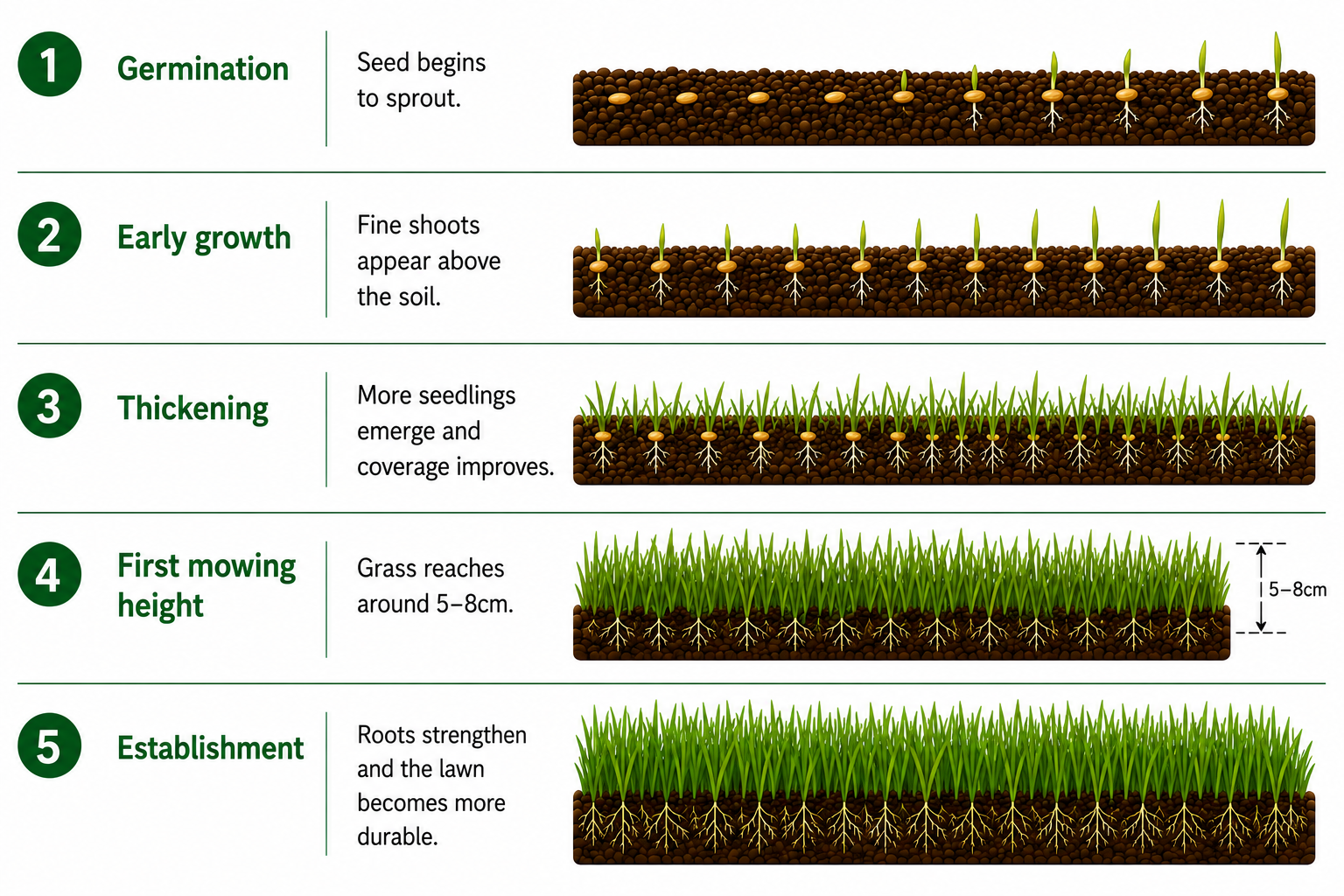
Most new lawns are ready for their first mow once the grass reaches around 5 – 8 cm high. This often takes 4 – 8 weeks, depending on the weather and growing conditions.
When mowing for the first time, keep the mower blades high and only remove the top of the grass. Cutting too short too soon can stress the young plants.
How long should you water grass seed for?
Grass seed should be watered immediately after sowing and then kept consistently moist until it has germinated and started to establish.
In dry weather, this may mean watering lightly once or twice a day. In cooler or wetter weather, less watering may be needed.
A simple watering guide is:
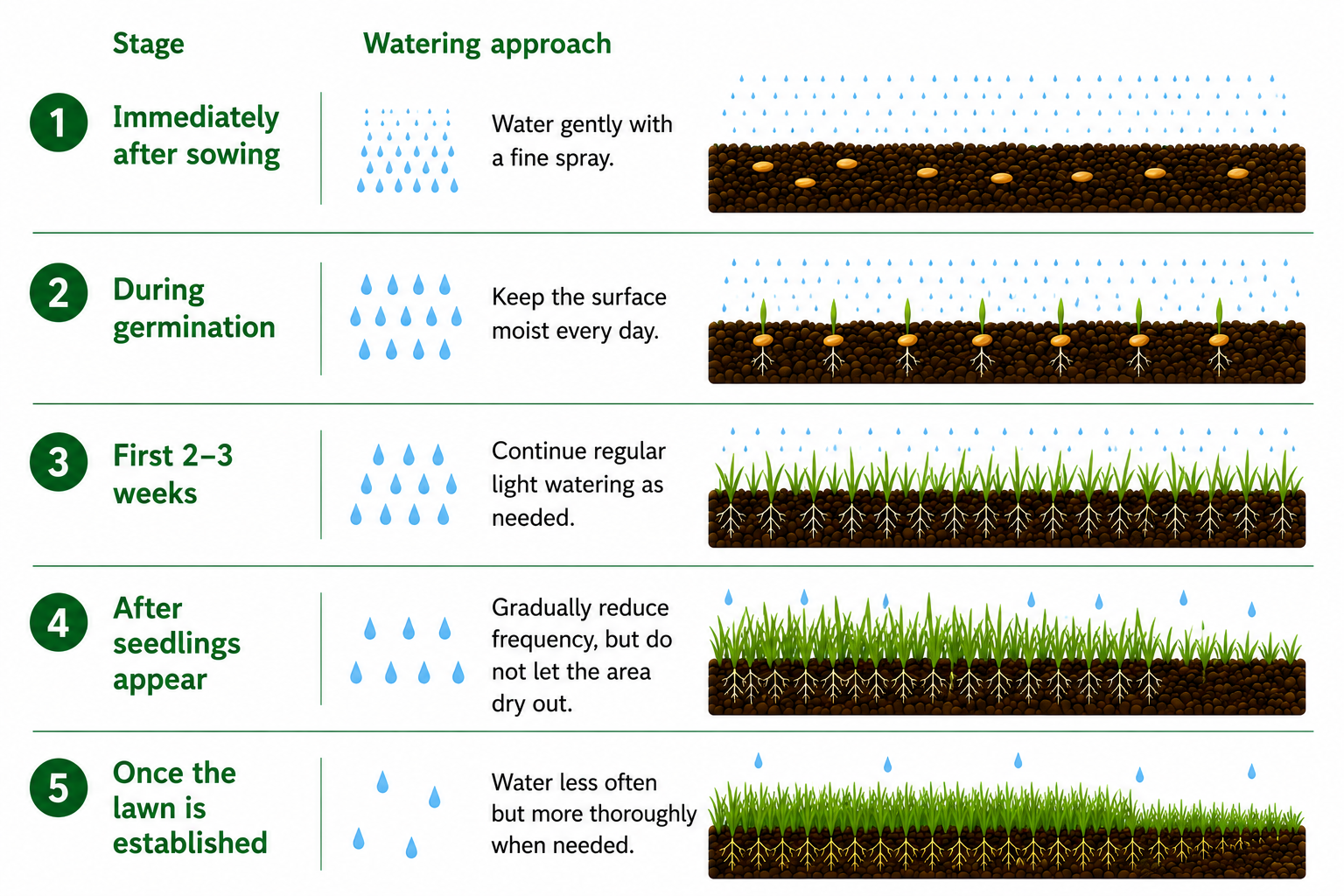
Avoid heavy watering that causes puddles or washes seed into low areas. The goal is moisture, not saturation.
How long does grass seed last?
Grass seed has a limited shelf life. Over time, its ability to germinate reduces.
Fresh seed will usually give the best results. Seed that has been stored for a long time may still grow, but it may germinate more slowly or unevenly. Opened bags are more likely to lose quality, especially if they have been exposed to moisture or temperature changes.
To keep seed in the best condition, store it in a cool, dry place, away from damp, pests and direct sunlight. Once a bag has been opened, reseal it carefully and use it as soon as practical.
Common reasons grass seed is slow to grow
If your grass seed is taking longer than expected. It does not always mean it has failed. Common causes of slow growth include:
| Reason | Why it matters |
|---|---|
| The soil is too cold | Cold soil slows germination. Seed may sit in the ground for longer before it starts growing. |
| The seedbed has dried out | Grass seed needs steady moisture. If the surface dries out repeatedly, germination may be poor or patchy. |
| There is poor seed-to-soil contact | Seed needs to touch the soil to root properly. If it is sitting on thatch, moss, stones or loose debris, growth may be uneven. |
| The seed has been buried too deeply | Grass seed should sit close to the surface. If it is covered too heavily, shoots may struggle to emerge. |
| The ground was not prepared properly | Compacted, uneven or weedy soil can slow establishment and cause patchy results. |
| The wrong seed was used | A seed mixture that is not suited to the site may struggle. For example, a standard lawn mix may not perform well in heavy shade, very dry soil or high-wear areas. |
| The seed is old or poorly stored | Older seed may have reduced germination. If the seed has been damp or stored badly, results can be unreliable. |
How professionals achieve reliable results
Professional results come from consistency. It is not only about spreading seed and waiting for it to grow. The best outcomes usually come from careful planning, correct product choice and steady aftercare.
Professionals focus on:
· Selecting the right seed mixture for the site
· Preparing the soil properly before sowing
· Sowing at the right rate
· Ensuring good seed-to-soil contact
· Timing the work around suitable growing conditions
· Keeping the seedbed consistently moist
· Protecting the area while the grass establishes
· Mowing at the right height once the grass is ready
For homeowners, landscapers and grounds teams, choosing a quality seed mixture makes it easier to achieve reliable results. Whether the job is a new lawn, lawn repair, shaded area, dry soil, heavy-use space or specialist site, the right seed will help improve establishment and long-term performance.
East Riding Horticulture supplies a range of professional grass seed options for lawns, landscaping and specialist conditions. Choosing a quality seed mix helps improve germination, establishment and long-term lawn performance, especially when paired with good preparation and consistent aftercare.
Explore our range of professional-grade grass seed for more reliable results.
Final thoughts: When will you see results?
In good conditions, you may see the first green shoots in 7 to 14 days. The lawn should start looking greener after 2 to 3 weeks, and it may be ready for its first mow after 4 to 8 weeks.
A full, established lawn takes longer. Allow several months for the grass to root, thicken and become more resilient.
If growth seems slow, check the basics first: soil temperature, moisture, preparation, seed age and whether the seed has good contact with the soil. In many cases, slow progress is normal and simply reflects the conditions at the time of sowing.